Surfaces Ready for Color Without Visible Seams
Drywall Finishing and Taping in Lewiston for walls and ceilings that show no trace of panel joints or fasteners
When drywall panels go up, the seams between them and the fastener dimples create visible interruptions across every surface. The Sheetrock Whisperer handles drywall finishing and taping in Lewiston, turning those raw installations into continuous surfaces that accept paint evenly. The process involves applying joint compound in controlled layers, embedding reinforcing tape, and progressively refining the surface until no joint lines or screw heads remain detectable under finish coats.
Finishing begins with taping each seam using paper or fiberglass mesh, then embedding it in a base coat of joint compound that fills the recess where panels meet. Successive coats widen the transition zone and feather the edges so the build-up blends invisibly into the surrounding drywall. Fastener holes receive similar treatment, with compound filling each dimple flush to the panel face. Sanding between coats removes ridges and tool marks, producing the smooth plane that paint requires to look uniform.
Schedule an estimate to determine which finish level matches your lighting conditions and intended wall use.
What Different Finish Levels Accomplish
Finish levels range from Level 1, where tape is simply embedded without additional coats, to Level 5, which adds a skim coat of compound over the entire surface. Most residential projects use Level 4, which provides smooth, paint-ready walls through three coats of mud and thorough sanding. Level 5 becomes necessary when severe side lighting or high-gloss paints will amplify even minor texture variations, particularly in hallways with windows at one end or rooms with track lighting that rakes across walls at low angles.
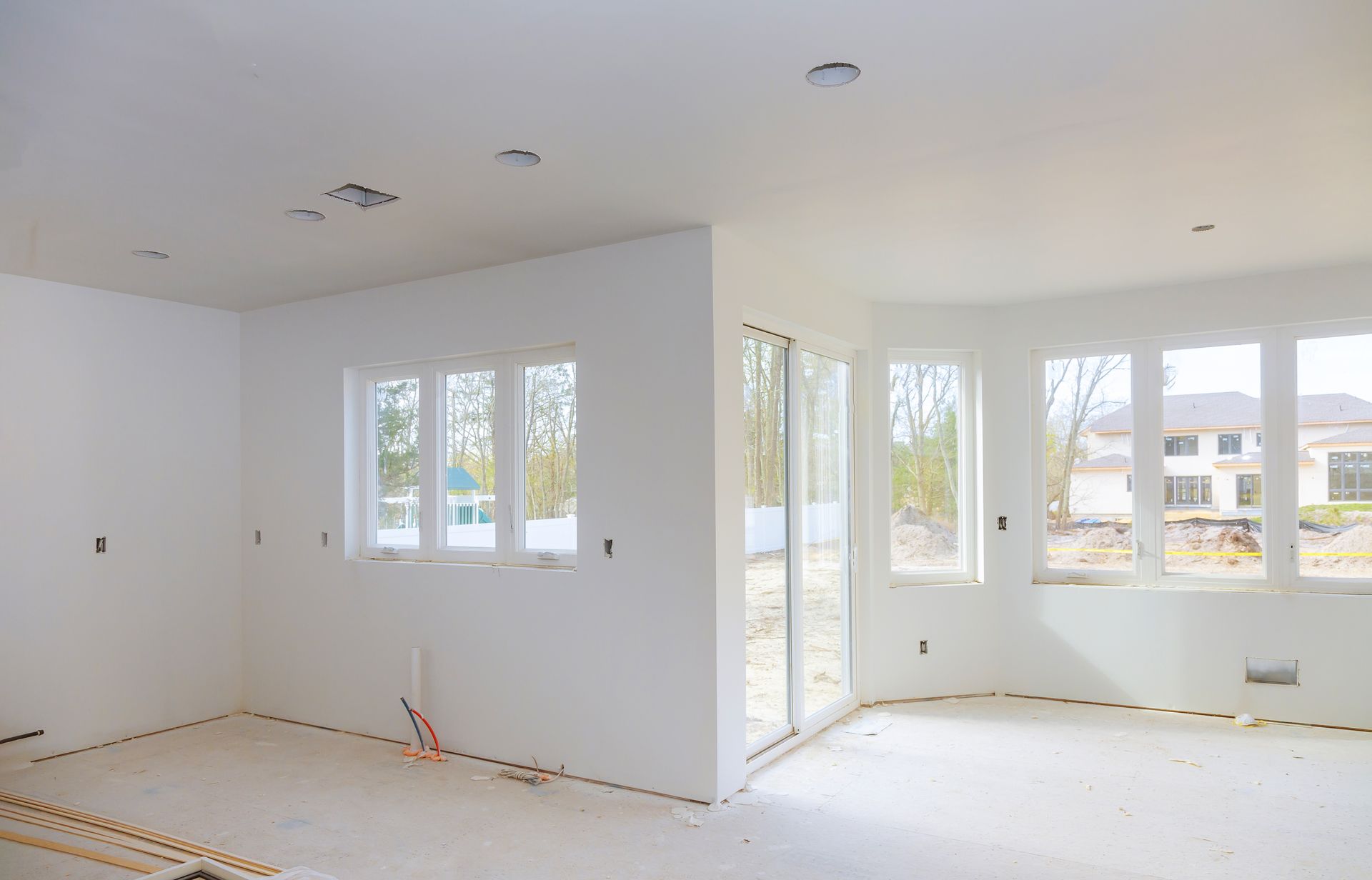
Once finishing is complete, you see walls where seams disappear entirely under primer and paint, with no shadows marking panel edges when light moves across the surface. Corners meet in crisp lines without gaps or compound build-up, and ceilings present a uniform plane that reflects light evenly. The difference shows most clearly in rooms with large unbroken wall expanses, where even slight inconsistencies in flatness create visible waves under certain lighting.
The number of coats and the sanding intensity determine how much surface preparation your painter will need before applying finish coats. Insufficient feathering at seam edges creates ridges that remain visible through multiple paint layers, while over-sanding can fuzz the paper face and create texture differences that show through flat paints. Proper finishing eliminates both problems, delivering surfaces that need only priming before color goes on.
What Homeowners Ask About Finishing Work
These questions come up frequently when discussing finishing and taping projects in Lewiston and the surrounding area.
How does winter heating affect drying time between coats?
Forced air heat in Lewiston homes during cold months lowers indoor humidity, which speeds compound drying but can also cause faster surface skinning that traps moisture underneath, requiring longer wait times between coats to prevent cracking as the material cures fully.
What causes seams to show through paint months after finishing?
Seams that telegraph through paint typically result from insufficient feathering at the edges of the joint compound, where the abrupt thickness change creates a ridge that becomes visible once multiple paint coats build up over it, or from using setting-type compounds that shrink differently than topping compounds during curing.
Why do some corners crack while others stay solid?
Inside corners experience more movement than flat seams because they form the junction between two planes that shift independently as framing settles or temperature changes, making paper tape with a crease more durable than mesh in these locations since it reinforces the angle without relying solely on compound for strength.
What distinguishes adequate sanding from excessive sanding?
Adequate sanding removes tool marks and feathers seam edges without breaking through the compound layer to expose tape, while excessive sanding roughens the drywall face itself, creating texture differences that absorb paint unevenly and show as dull spots compared to the smoother joint areas.
When does a project require a skim coat over the entire surface?
Skim coating becomes necessary when critical lighting conditions will expose any texture variation, when transitioning between old and new drywall sections that have different surface characteristics, or when walls will receive high-gloss or metallic paints that amplify even minor imperfections invisible under flat finishes.
The Sheetrock Whisperer provides finishing work matched to your specific lighting conditions and paint choices. Request a project consultation to review finish level requirements for your space.